

Milk and Wine
Right now, all across the South, a crinum is blooming in forgotten places . Old cemeteries. Fence rows. The corner of a parking lot beside a building that used to be some Granny’s house. That’s Crinum x herbertii — the Milk and Wine Lily — and it is almost certainly the most widespread crinum in America. Striped pink and white, fragrant, chest-high when it’s happy, and absolutely indifferent to neglect.
It’s a Southern icon of a flower. We used to think it was only Southern but now, since I’ve been sharing them across the country for decades, we know it is cold hardy well up into Zone 6 and beyond — West Virginia, parts of Pennsylvania and New York and even near Toledo. It has been handed off between neighbors as a bulb division and quietly spreading.
That spreading is why it’s so variable. Drive a hundred miles and the Milk and Wine at the next old homeplace looks almost — but not quite — like the one you left behind. A little pinker. Slightly wider stripes. Blooms a week earlier. I have four of them- all with different names folks have given them. You tell me which is which. I sure can’t tell them apart.
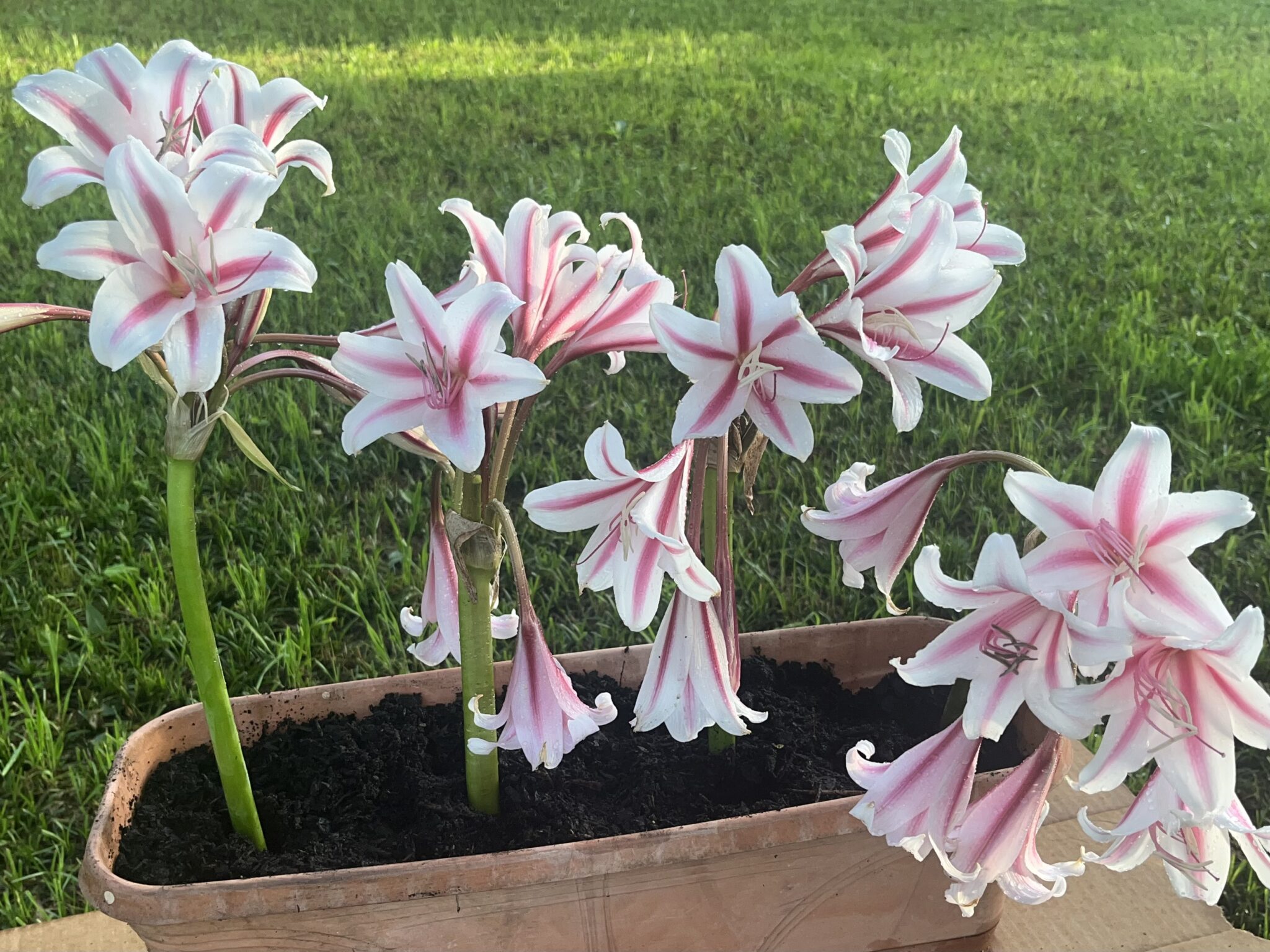
So if you spot one in a granny’s garden or an old cemetery and want to know its name, be satisfied with Milk and Wine Lily or Herbert’s Crinum. That’s its name. That’s enough.
Love your crinum. Name it if you want. Just hold that name loosely and keep it close to home.
If you want to call yours Aunt Pearl’s, or Cemetery Road, go ahead. Naming a plant after a person or a place you love is one of the quiet joys of gardening. It matters to you, and that’s exactly where it should stay. But it isn’t is a cultivar name. Slapping an official-sounding name on a plant without knowing for certain it’s genuinely distinct from the thousand other slightly-different herbertii clumps out there — that’s how confusion spreads faster than the bulbs do. The horticultural world has enough of that already.
The man behind the botanical name never saw any of this. The Hon. and Rev. William Herbert was an English clergyman and one of the first serious crinum breeders — androgynous-looking fellow in his portraits, which I appreciate — who never left his greenhouse to do his work. He crossed Crinum bulbispermum with C. scabrum and produced this hybrid entirely under glass in England. Charles Darwin thought enough of Herbert’s crinum experiments to cite them by name in On the Origin of Species — Herbert had found that his crinum crosses produced perfect fertility in every single ovule, which was exactly the kind of evidence Darwin needed.
Herbert never saw the South. He never saw a Pennsylvania roadside or a Virginia churchyard full of his crinum either. But the plant found its way there anyway, moved into the ditches and dooryards, and decided to stay.
Can’t argue with that kind of judgment.

My good friend Terry always calls them ‘milk and wine lilies’ I always called them ‘cemetery lilies’ because the only place I ever saw them was in old cemeteries. Is that I know they are ‘crinums’- they are still milk & wine or cemetery lilies.
Cemetery lily is a South Carolina term!
Beautifully written and love the poem!
I Loved my visit to your lovely farm, and the two Crinum I bought I potted up to keep close this summer and plant out in the fall . Nancy